Visitor Immigration Medicals in Ajax: Preparing During Your Stay
Prepare for a requested visitor medical without confusing a clinic appointment with an immigration status decision or your wider travel arrangements.

When you are visiting family or spending time away from your usual home, even a routine appointment can take extra planning. You may not know the local roads, your medical records may be overseas and the person helping you may have a work schedule of their own. An immigration medical request adds an official deadline to those ordinary practical challenges.
A visitor immigration medical in Ajax should begin with the instructions that apply to you. Not every visitor needs an examination, and attending a clinic does not itself extend a stay or decide an application. Once the requirement is clear, you can organise the appointment as a separate, manageable task.
This guide is for visitors arranging that medical step while relying on temporary accommodation, family support or unfamiliar local transport. It focuses on keeping documents accessible, preparing useful information and maintaining a reliable way to receive follow-up after the appointment.
Establish why the medical is being requested
Find the original instruction or official guidance that prompted the booking. Is there a message addressed to you, a requirement connected with your application, or a question that still needs clarification? Write that down before looking for a clinic appointment.
IRCC’s medical guidance for visitors, students and workers explains how factors such as planned stay and relevant travel history affect requirements. Check the current page and your own instructions.
If you are unsure whether an examination is required, resolve that question through the appropriate immigration guidance or adviser. A relative’s experience from another visit may not match your circumstances. The clinic can discuss its services and appointment requirements, but an available time slot is not evidence that every visitor should book a medical.
Keep your appointment and status questions distinct
It is understandable to hope that completing one important task will resolve the rest of an application. Still, the medical appointment and permission to remain in Canada are separate matters. Keep any status-related deadlines visible in your own planning and follow the appropriate official process for them.
When asking for help, name the question accurately. “What do I need to bring to the medical?” belongs with the clinic. “What does this application instruction mean for my stay?” may require official immigration guidance or qualified advice. Separating those questions makes the answers more useful.
Do not use an appointment confirmation as a substitute for reading a government message. Save both, label them clearly and record any action each document requires. This prevents a busy travel week from creating the mistaken impression that booking the clinic has completed an unrelated administrative step.
Check identification before making other arrangements
Visitors sometimes have identification involved in another process, stored with a host family member or packed away for travel. Confirm what you need for the appointment and make sure the document will be available on the day. If it is not, contact the clinic early about approved alternatives.
Compare the name used for booking with the identification and any medical request. Different naming conventions, multiple given names or a recent name change can create uncertainty. Ask how to present the information rather than shortening or rearranging it simply to fit an informal booking note.
Keep the important documents in a small folder you can reach easily. A suitcase full of travel papers is inconvenient at check-in, and a host should not need to search through your belongings to find an instruction letter. The person attending should know where the documents are and what each one is for.
Retrieve useful records from home
Think about what will help you explain your current health. A medication list, a relevant specialist report or a recent treatment summary may already be available electronically. Start with those records instead of asking a doctor overseas to create a new document without knowing whether it is needed.
If a family member at home helps find records, give a specific request. “Please send the report from my last specialist visit” is easier to act on than “send everything medical.” Check that scans are complete, readable and clearly associated with your name.
Contact the clinic if you are uncertain about a report’s relevance or language requirements. Time differences can make document retrieval slow, so ask early where possible. Do not guess a diagnosis or date because a record has not arrived; explain what you know and what remains uncertain during the medical conversation.
Make your medicine information easy to interpret
Bring the names and doses of the medicines you currently use. If the packaging comes from another country, labels or a pharmacy record can help clarify the exact product. A relative may know why you take a medicine without knowing its full name.
Review the list yourself, even if someone else types it. Mark changes clearly and distinguish current treatment from older prescriptions you no longer use. Include the schedule accurately rather than trying to simplify it for the appointment.
Do not change your usual treatment merely because you are attending an immigration medical. Follow your treating clinician’s advice and any specific instructions for the visit. If you have a question about a medicine or a health concern while travelling, seek appropriate healthcare advice rather than using an appointment-preparation article to decide what treatment to take.
Decide how your host can help
A host may offer transport, language support or help with booking. Ask for the assistance that actually makes the visit easier, and discuss any part you would prefer to handle privately. Staying in someone’s home does not mean they need to manage every health conversation.
If your host calls the clinic, make their role clear. Staff may answer general scheduling questions while needing your involvement or authorisation for personal matters. Keep your own contact information on the booking where appropriate so you are not dependent on someone else’s availability for every update.
If interpretation is needed, arrange it with the clinic in advance. A host who is comfortable translating restaurant menus may not be comfortable with medical terminology or sensitive questions. Confirm what support is available and acceptable rather than relying on an improvised arrangement at reception.
Plan the route from your temporary address
Save the clinic’s complete address: Suite 403, 300 Rossland Road East, Ajax. Share it with the person driving or use it when planning your own route. The suite number matters, especially in a building with several services.
Free parking is available on site. Physician assessment and bloodwork are offered on site, with chest X-ray services in the same building. Ask the clinic which services are expected and how much time to allow. Convenient services do not remove the need to plan the full visit.
Consider the return trip as carefully as the journey there. A host may be available in the morning but need to return to work later. Avoid depending on an exact finishing time that has not been confirmed. Use the contact page for practical questions and the booking page to review appointment options.
Budget without assuming another policy covers the visit
Visitors may have travel insurance, employer assistance or a family member helping with expenses. Do not assume any of those arrangements automatically covers an immigration medical. Ask the relevant insurer or payer what its policy includes and what documentation it requires.
Review the clinic’s current prices and confirm the fee for your appointment. Ask what is included and how you would be informed about costs if further services were needed. Clarify payment arrangements before attending, particularly if someone else is paying from a distance.
Keep receipts with your own records. If you plan to request reimbursement, send the required payment documentation through the appropriate process. Medical reports and financial receipts serve different purposes, and keeping them separate makes it easier to share only the material relevant to the request.
Prepare for an appointment in an unfamiliar system
Healthcare procedures may look different from those in your usual country of residence. It is reasonable to ask how check-in works, what will happen during the visit and how instructions will be provided afterwards. A short list of questions can help you remember what you wanted to understand.
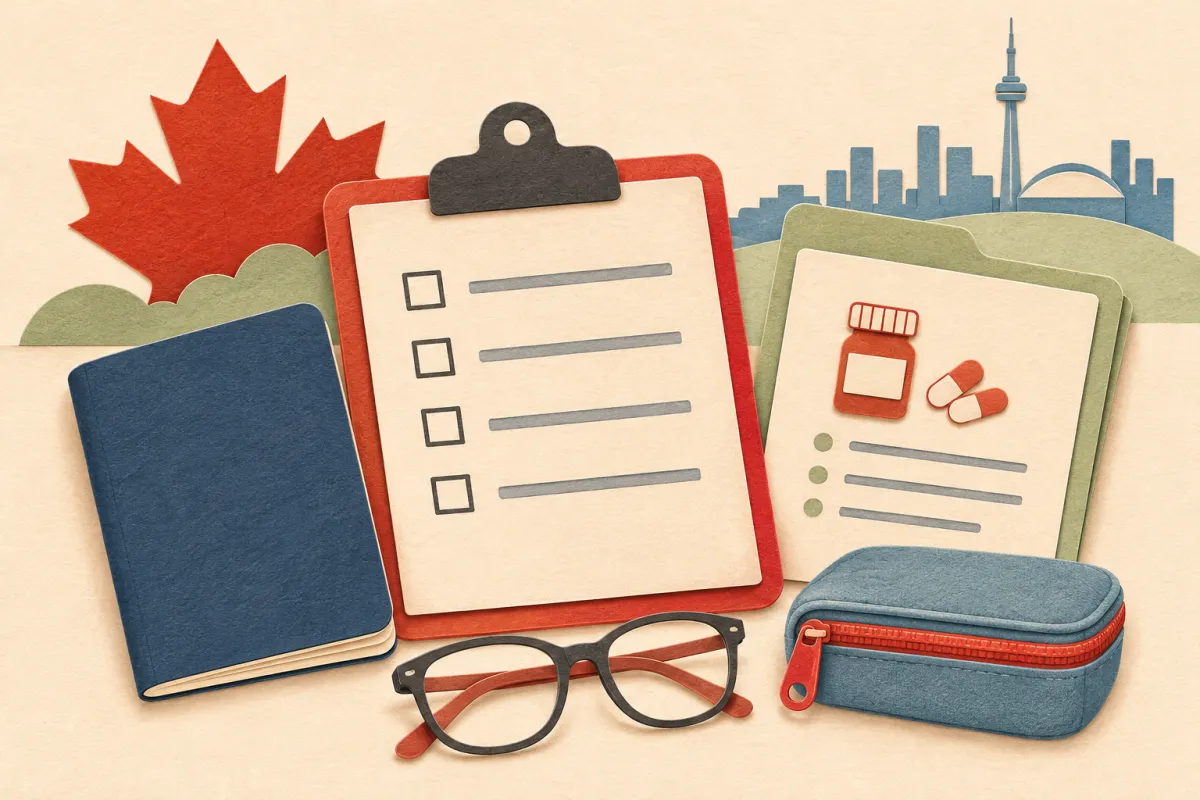
Review the exam preparation checklist before the day. Bring the usual aids you rely on, such as glasses, and discuss practical support needs with the clinic. If you want a companion for part of the visit, ask how that can be arranged.
During the appointment, say when an explanation is unclear. Do not agree that you understand an instruction merely because others seem busy. Repeating the next step in your own words can reveal a misunderstanding before you leave, when it is still easy to ask for clarification.
Keep follow-up working after you change locations
You may move between relatives, continue travelling or return home after the appointment. Give the clinic a contact method you can continue to access and ask how to update details if they change. A local number that will stop working soon may not be the best sole contact.
Before leaving, ask whether any action remains outstanding and how the clinic will communicate with you. Save the appointment date and documents in a secure location accessible from the device you expect to use while travelling. Keep a backup if the phone you normally rely on is lost or replaced.
If another report is requested, confirm the exact item and how to send it. Do not assume that returning home ends your part in the process. Equally, do not arrange repeat testing merely because you have changed location; ask what is actually required and follow the relevant instruction.
Put the medical record in the right part of your travel plan
After the visit, check the identifying details on the confirmation you receive and store it with the relevant application records. Keep the original wording intact. If there is an error, contact the clinic about correction rather than editing the file yourself.
Use precise language when updating relatives or an adviser. Attending the appointment, completing a clinic submission and receiving an immigration decision are distinct milestones. Knowing which one has occurred makes the next conversation more productive.
The clinic’s Immigration page brings together services, preparation and location details. Once the medical requirement is understood, a practical plan for documents, travel and communication can make the appointment easier to manage during your visit, even when your ordinary home and healthcare records are far away.
Ready to plan your visit?
Our Ajax team can help with appointment details, preparation and questions about your visit.